On Charles Dickens’ “What Christmas Is as We Grow Older”

Tags

, , , ,

In my last post, I considered what it would be like to read Poe’s “Tamerlane” and other works by nineteenth-century “celebrity” poets as a student in 1935. I also considered, more silently, the imagination’s ability to reconstruct past scenarios, perhaps accurately, perhaps inaccurately. Inaccurate representations can be as valuable as accurate ones, because they tell us about the writer’s world, if not about the world they seek through imagination. Published histories tell us what was important to the writer and perhaps their audience at the time they were published. They may also tell us some things about the past, but as a student of archival studies will learn, histories are stories constructed from archival materials, interpretations of primary sources that inevitably favor some ideas and disfavor others.

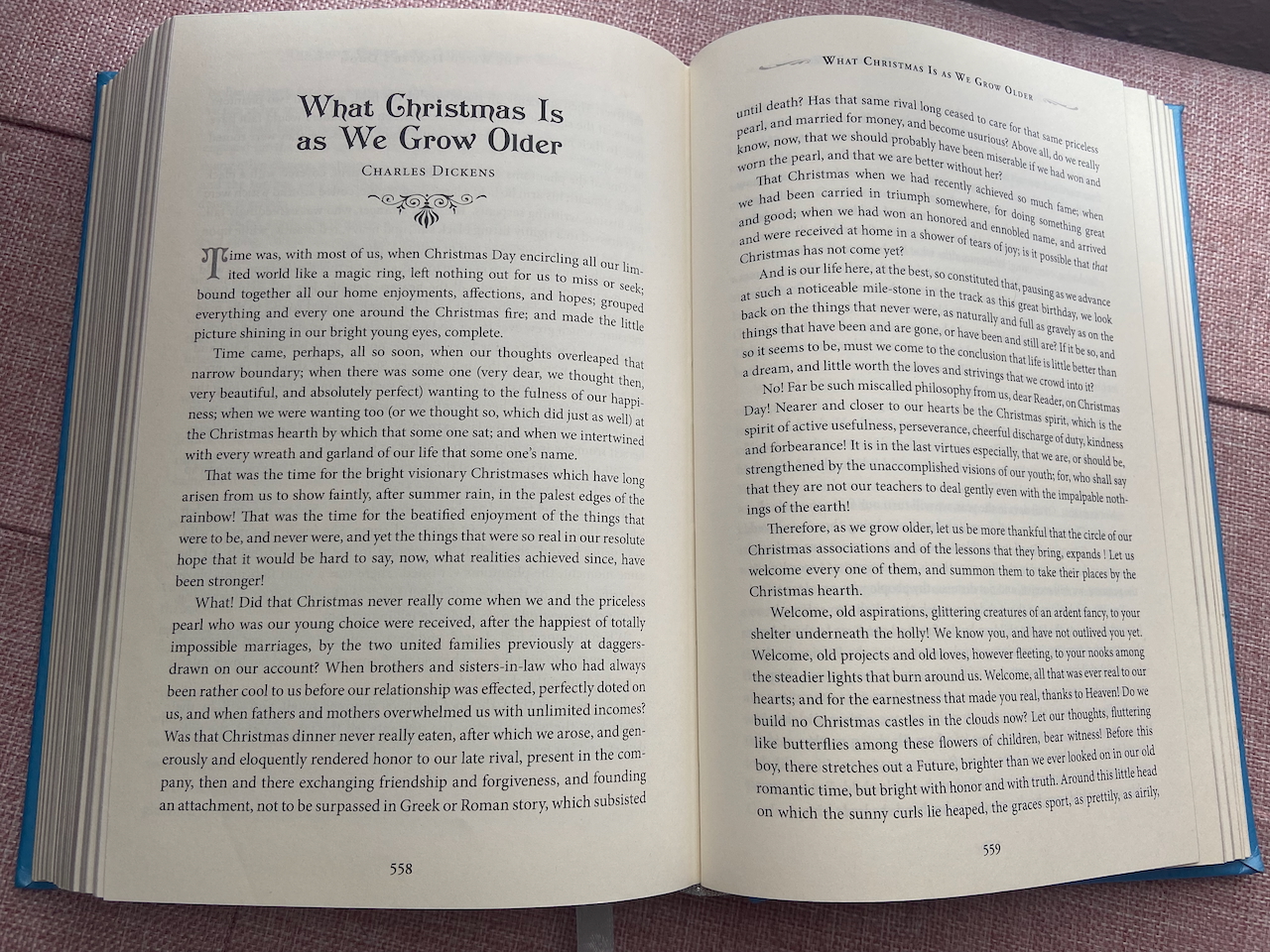
I applied this kind of thinking to my re-reading of Charles Dickens’ 1851 essay “What Christmas Is as We Grow Older,” in how my own response to the essay prompts a series of questions about the world in 2025.
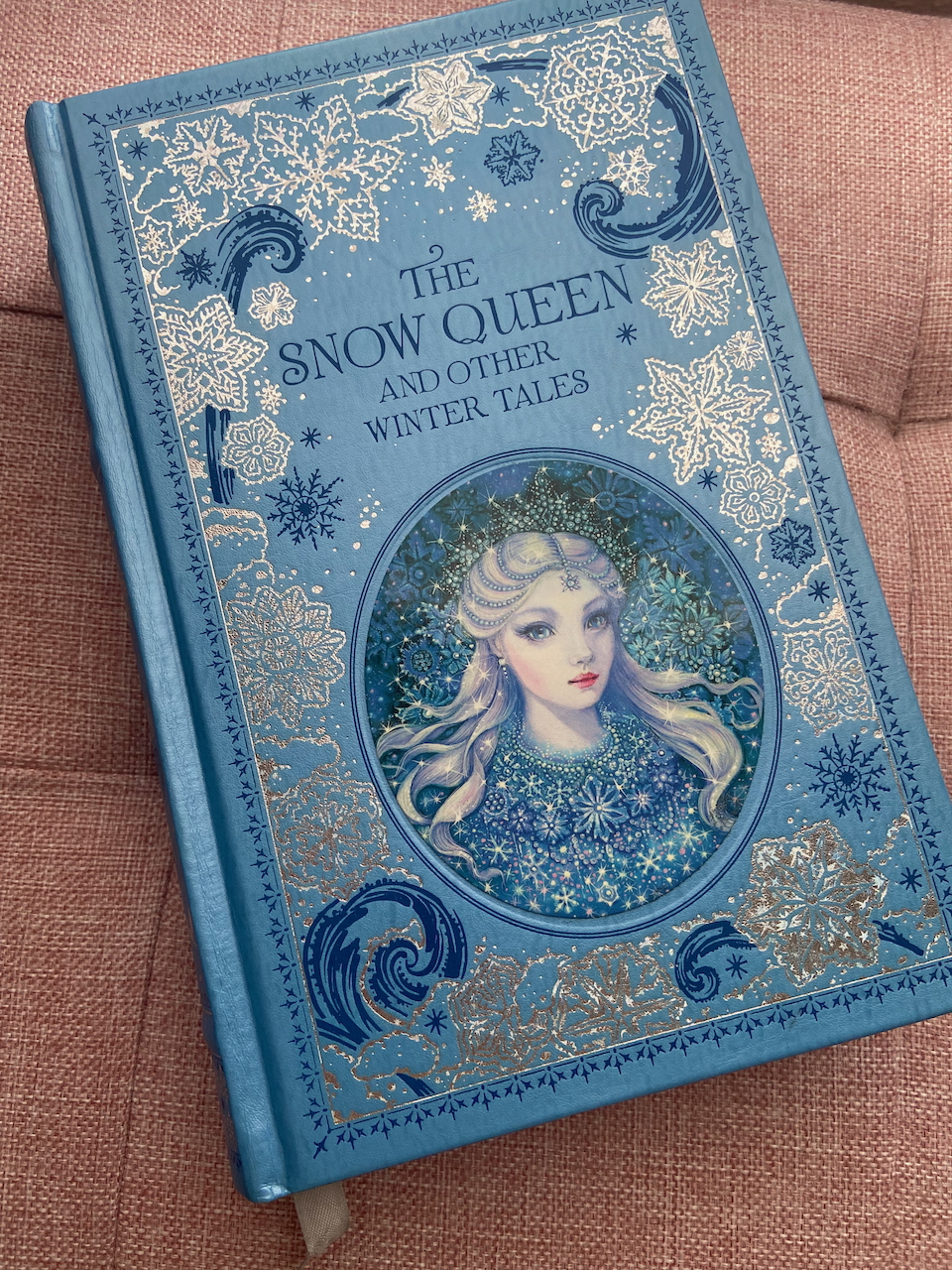
This essay is part of Barnes and Nobles’ 2015 anthology The Snow Queen and Other Winter Tales. The anthology, on the whole, communicates a darker tone than one might initially associate with the crystalline beauty of winter and the festivities of Victorian Christmases past. Dickens’ essay is far from the darkest work in the anthology. I think that falls to the writings of Hans Christian Andersen, whose stories in this anthology speak more about the cruelty of the wintry internal landscape of the human than the extreme hardships common folks experienced in the winter season prior to electricity and what we call modern conveniences (though the stories of that sort are thought-provoking to read as well).

Charles Dickens’ essay begins with a cynical and somewhat seemingly self-torturous recollection of Christmases-that-never-were, in convoluted sentences that I have to read at least twice over to fully catch:

What! Did that Christmas never really come when we and the priceless pearl who was our young choice was received, after the happiest of totally impossible marriages, by the two united families previously at daggers-drawn on our account? When brothers and sisters-in-law who had always been rather cool to use before our relationship was affected, perfectly doted on us, and when fathers and mothers overwhelmed us with unlimited incomes? Was that Christmas dinner never really eaten, after which we arose, and generously and eloquently rendered honor to our late rival, present in the company, then and there exchanging friendship and forgiveness, and founding an attachment, not to be surpassed in Greek or Roman story, which subsisted until death?

For the sake of Dickens’ wife at this time, Catherine Thomson Hogarth, who must have been quite busy birthing and raising the ten children he sired with her, while he was writing, I am hoping this was a hypothetical scenario, especially as it advances that the “pearl,” or longed-for woman the speaker was never able to marry, is compared to the present wife, “placider but shining bright — a quiet and contented little face” in which the speaker sees “Home fairly written.” The essay, rather, traces ideas of looking at a very early childhood Christmas, which “encircl[ed] all our limited world like a magic ring, left nothing out for us to miss or seek… grouped everything and every one around the Christmas fire; and made the little picture shining in our bright young eyes, complete,” then turns to view adolescence and young adulthood, when that wholesome picture becomes more fragmented, and Christmas becomes a time of longing for fulfillment rather than one of completeness.

Then, the essay lapses into what is for me, at least, some painfully sentimental prose about “a poor mis-shapen boy on earth… of which his dying mother said it grieved her much to leave him here, alone.” However, “he went quickly, and was laid upon her breast,” and subsequently, the tragedies of a young soldier dying “upon a burning sand beneath a burning sun,” and “a dear girl– almost a woman– never to be one” who “went her trackless way to the silent City,” are presented as objects to grieving relatives and acquaintances.

When I read the essay closely, I do not see what I had hoped to find, what I always hope to find in works from centuries past: a common thread of humanity binding us more closely than world events, technologies, and changing cultures can sever or distance. Sometimes I find this reassurance and take much comfort in it, but today I didn’t, somewhat repelled by Dickens’ sentimental gloss on suffering. Instead, I consider how many more conflicts the West has entered into “upon a burning sand beneath a burning sun” and otherwise (several in my lifetime alone), how head-of-household women and their children suffer due to inadequate medical care, and a variety of atrocities arisen in the last 174 years which have no equivalents in this essay.

The answer he presents in the face of the cruelties of present reality is one of remembrance: “You shall hold your cherished places in our Christmas hearts, and by our Christmas fires; and in the season of immortal hope, and on the birthday of immortal mercy, we will shut out Nothing!”

There is no doubt that, as we grow older, we will have experienced many more deaths, which lends perspective to life. But cultural epochs have gone and gone since Dickens and now. Namely, the rise of modernist thought, suspicious and cynical by nature, in the late nineteenth- and early twentieth-centuries, to give way to the postmodernists, and their successors, who still grapple with modernity’s darkness in factions so fragmented that it sometimes seems hard for one liberal line of thinking to meet another.

I think, whether we believe in Strauss-Howe generational theory, or not (and I can definitely see both sides of that argument), we do feel that we are plummeting quickly to the bottom of something. The consumerist nature of Christmas has escalated in the past two centuries so that I, for one, cannot conceive of it without its glittery excesses. As Western capitalism fails in an extraordinarily ugly demise, the glitter becomes a frenetic malaise of packages no longer delivered in one or two days or postponed and cancelled grocery deliveries (all of which, if we are being honest, we feel gross for purchasing in the first place), and of coffee shops that drive us out of a moment of respite with intentionally headache-inducing lights and music. The formerly great giants of retail famously killed off smaller fry once upon a time, to become wastelands of empty shelves mingled with shelves that look like a bomb went off in them. On observation, we find that some offhand household item or other we need is no longer sold in a brick-and-mortar shop at all. We wonder if the decor we hoped to find to beautify our spaces that looks so peculiar has been designed by AI. We log in to online platforms to catch glimpses of relatives or acquaintances that are all but completely lost beneath piles of endless streams of rage bait to which we never subscribed and whose algorithms we have not encouraged.

Modern life as we know it is enshittified, and we may feel ashamed to feel a sense of suffering over it, when surrounded by what we know to be real and profound suffering in the world. We do have the world of suffering in common with Dickens, even if we conceive of it and express it differently. Extreme poverty and sickness were not strange in Dickens’ era, nor were steep class divisions, and especially not the racialization of labor. In present-day America, we are experiencing these through a haze of AI-generated trash and a creeping awareness of the dearth of ethics possessed by those that puppeteer our lives with our dependencies.

It does not feel like Christmas radiance can be generated through taking a step back and a deep breath and thinking of those that have gone before that we carry with us in spirit. The present is just too present.
Cultivating imagination in quiet places

Tags

, , , , , ,

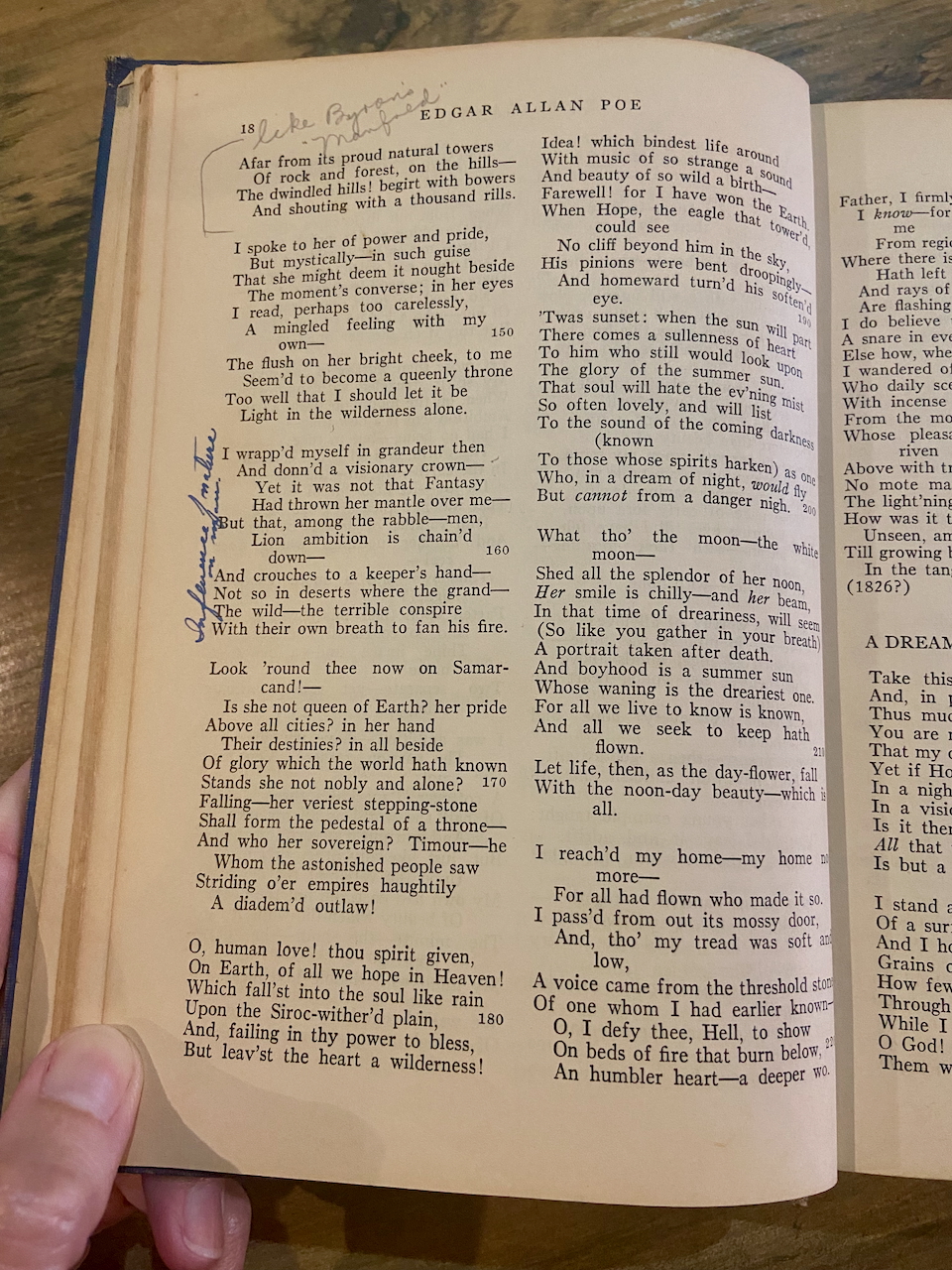
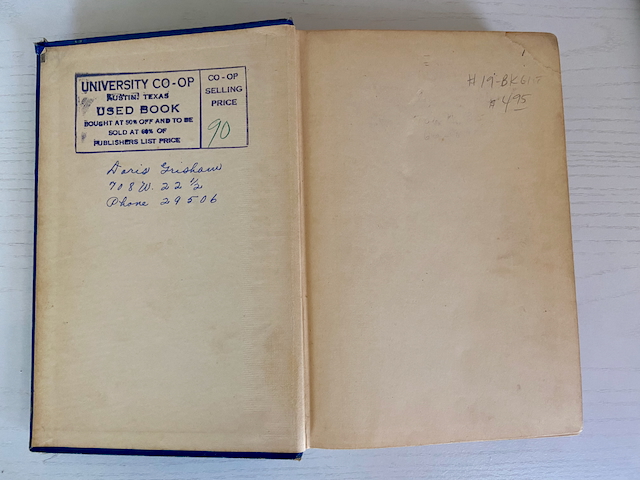
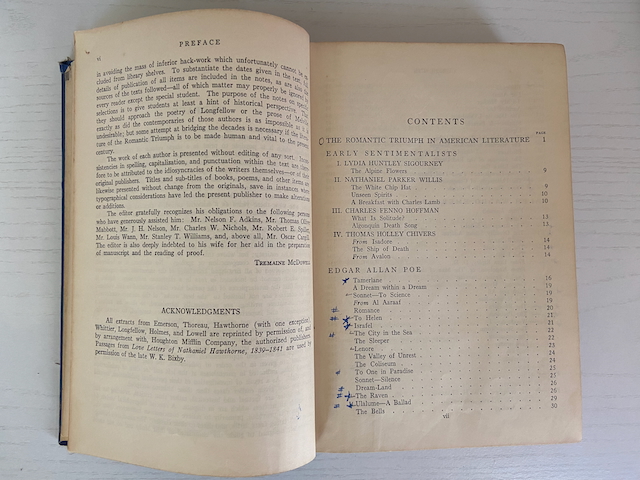
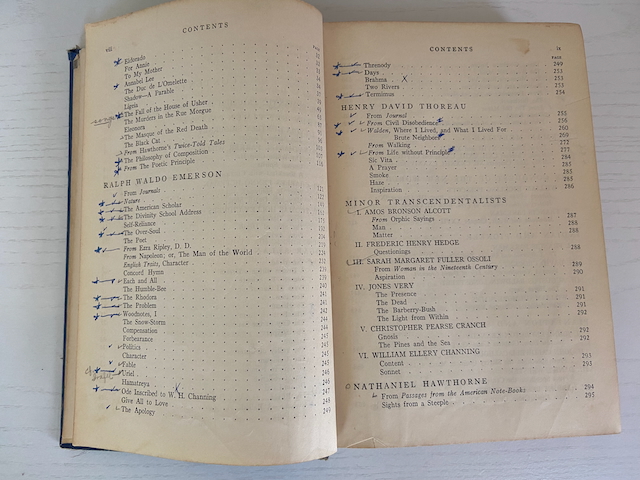
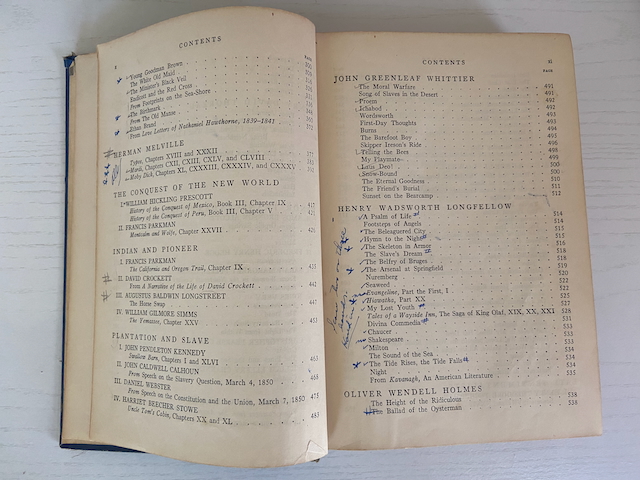
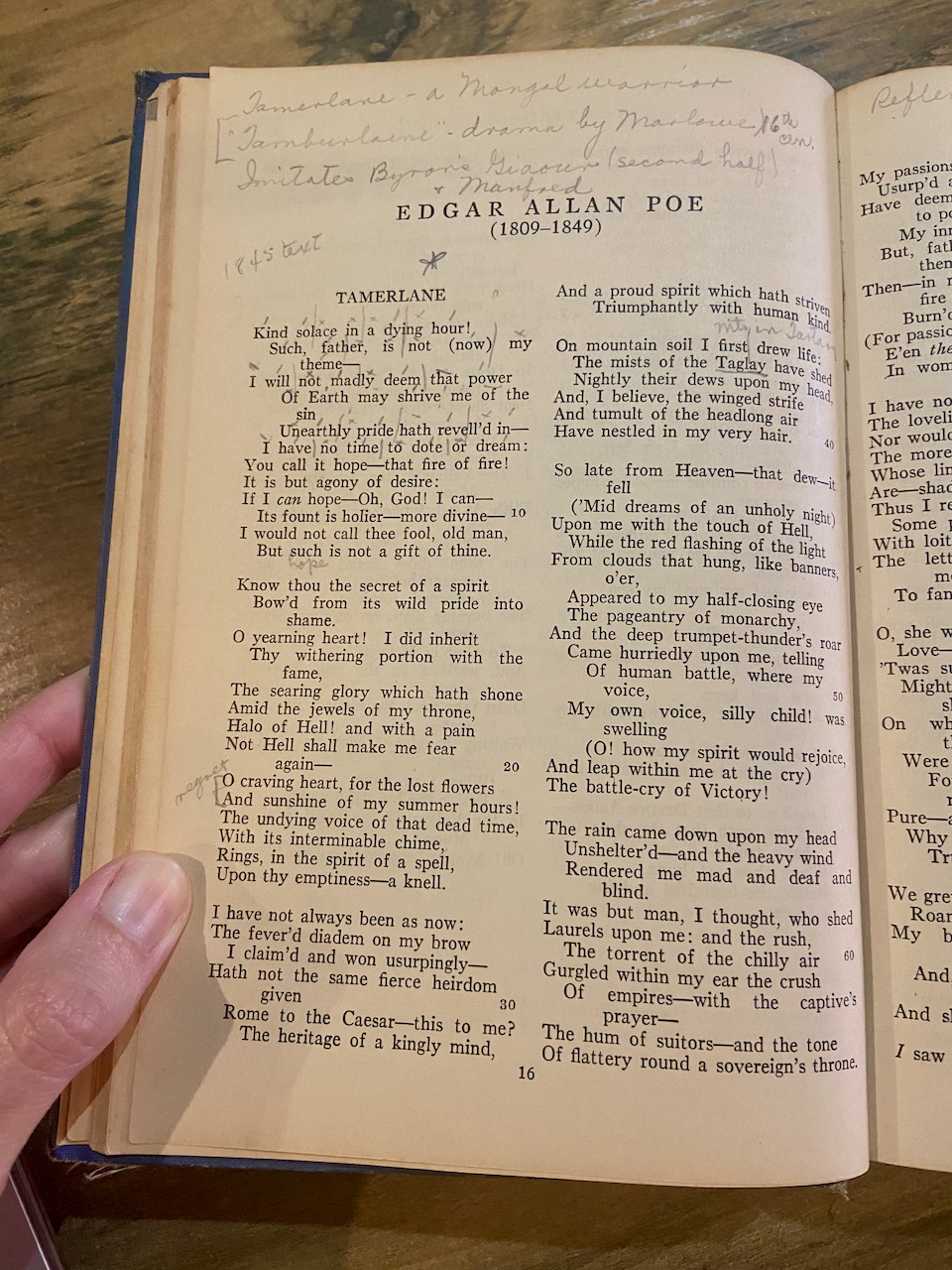
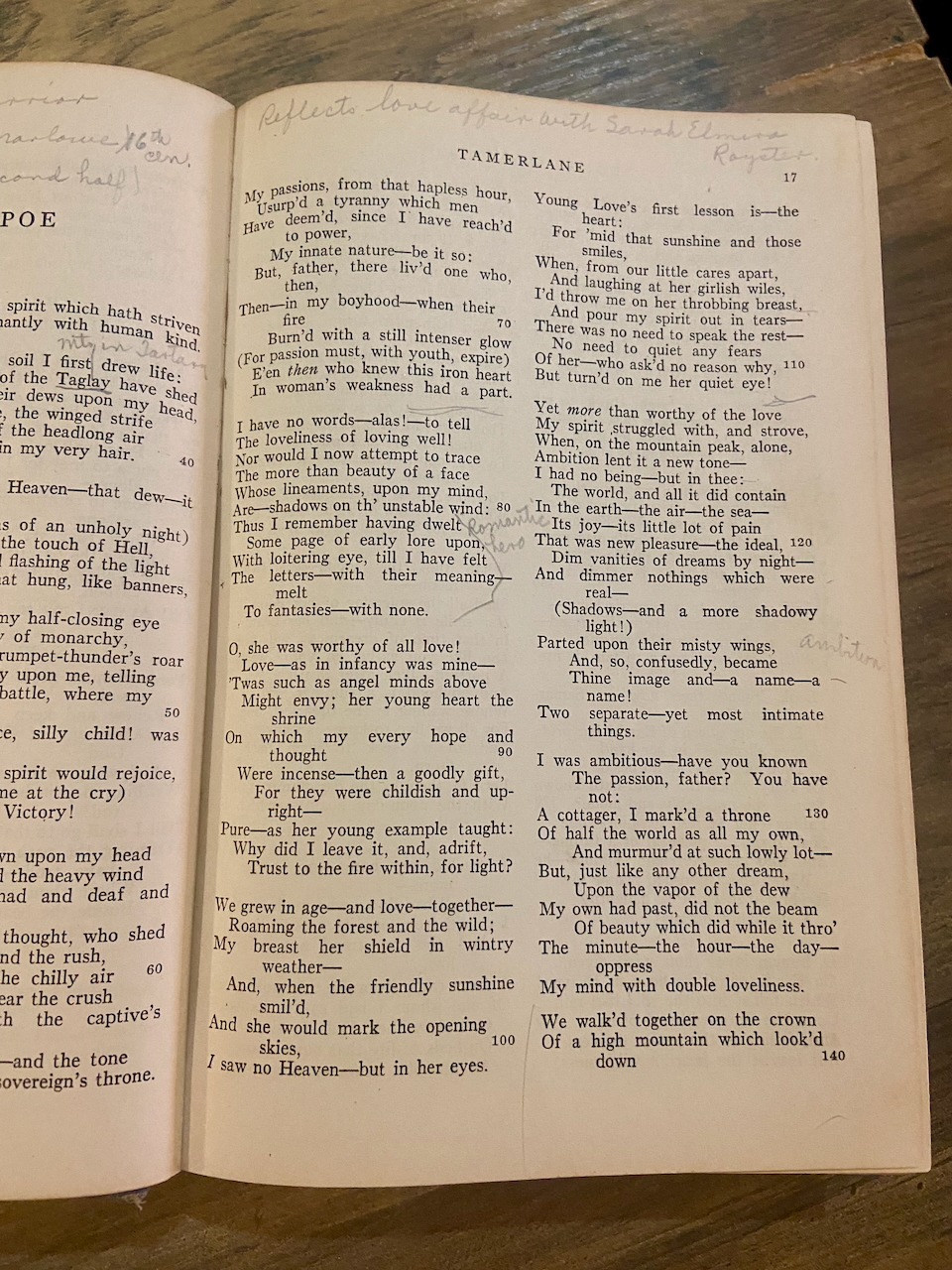
In my last post, I reflected on an American literature anthology published in 1935 and what the book’s secondary markings, table of contents, and editorial preface could suggest about its role in its place and time. My working hypothesis based on those elements is that this book was assigned as a textbook at UT Austin for an American literature course, perhaps a sophomore literature course, and that it was used by at least two students, one of whom was named Doris Grisham and took extensive notes throughout the text on the assigned readings.

I wondered how usual it was for a woman to attend college in the 1930s and 1940s. At its inception in 1883, 26% of UT Austin’s students were women. From what I could find on Wikipedia and other sources, this number grew steadily until today, when a little over half of college students enrolled are women. I even read on Wikipedia that doctoral degree-earning peaked for women in the 1930s and opened more fields for them. It seems likely that around 40% of students enrolled at UT Austin during Doris Grisham’s time were women. Thus, my stumbling across a textbook used by a female student does not have such a low probability.

When I left off on this post two weeks ago, I felt a little bit lost looking over those marked-up texts. It was fairly easy to guess that lessons had been supplied on the rhythm of the poetry, judging by the markings over stressed and unstressed syllables. I remember learning about the various rhythms poetry can take in high school. However, the lessons never took on much significance for me beyond mastering a skill for a test. I never grasped the significance of poetry in the 19th century and earlier, when rhythm and rhyme were such crucial elements. I knew the point of learning about rhythm and rhyme for the classroom was to earn a good grade and, more vaguely, to develop an educated appreciation for literature. I knew I loved literature, but did I love it or understand it in the same way that its original recipients did?

That question has been the focus of my musings for the past week, and my conclusion was, definitely not. I don’t think I’m able to conceptualize the popularity of poetry or the celebrity of poets except by comparing them to contemporary celebrities, which hardly seems like a fair or congruous comparison.

One article that gave me insight of these contexts was Jill Lepore’s “How Longfellow Woke the Dead,” published in The American Scholar in Spring 2011. Another was David Haven Blake’s “When Readers Become Fans: Nineteenth-Century American Poetry as a Fan Activity,” published in 2012 in vol. 52. no.1 of American Studies. My dives into these articles have left me two distinct ideas so far:

One, that poetry was for everyone. Poetry was read aloud in social or public gatherings and at life events like weddings or funerals. Rhythm and rhyme were elements that were important when poetry was spoken aloud and were elements that made poetry fun for children to read aloud. Poems were memorized and performed or chanted together. The themes of poetry were broad and universal, making them accessible to everyone. The intertextuality in poems, allusions to other works, made them stimulating and multidimensional to readers educated in classic literature and philosophy, or perhaps, in the absence of such an education, piqued the audience’s interest or allowed them to begin gathering impressions of them.

Two, that there was an intimacy in the words of a poet that may transcend the intimacy that contemporary celebrities project through their bodies of work, instilling emotions of intense passion in their audience. Poems were not necessarily meant to always be read aloud. Instead, many volumes of poetry were meant for private consumption, for dwelling deeply on what lines and phrases suggested about the poet’s experience, engendering the reader’s involvement and identification with the poet. Unlike contemporary celebrities, it was probably not possible to know exactly what a poet looked like or sounded like, or the specific details of their lives, though I get the impression that journalists did as much as they could to share this information, because there was so much public demand for it. Whitman received letters detailing explicit passion inspired in his readers, and Longfellow received surprise visits at his home from a variety of strangers who thought of him as a kind of public property.

I wonder if this sense of intimacy transcended contemporary parasocial feelings toward celebrities when poetry was read in the quiet that encourages free and deep thinking, and in the absence of any visual and aural counterparts of the writer, leaving the reader’s imagination to activate and strengthen over time toward literary pursuit.

To return to the margins of “Tamerlane,” I noticed that all of the extra-textual references recorded about Marlowe and Byron, as well as the poet’s relationship with Sarah Elmira Royster, were detailed in the biographical footnotes at the back of the book. This suggests that the book’s footnotes were taught directly as course material or that the book’s owner was studying it on her own. Since the footnotes cluster around the time-honored “masters” of American literature, though, I lean toward believing the former idea.

Speaking from experience, I find that intertextual references offer pleasurable insights into a text when I have actually read the work that is referred to; however, more often than not, I feel that creeping sense of a towering canon of literature that I should have read, and didn’t, and maybe didn’t even know about, and feel disconnected from the work that I am reading because it clearly wasn’t meant for me.

I guess that at least some nineteenth-century readers may not have read these works either, especially if they were educated in a more rural environment, and that the references did not present this kind of distraction because the readers were consuming the poetry as a force sympathetic with their own feelings.

I wonder what it would take to come to this kind of place again, in which a desire to connect with an unseen other is cultivated through words, intellect, and imagination, or if this poetry represents a brief cultural preoccupation with this imaginative play that will never been realized in humankind again.

Notes on a 1935 literature textbook

Tags

, , , , , , , ,

There are a few classes I took in graduate school that opened my eyes to new ways of seeing books as three-dimensional objects. These classes taught me how much you can read from a book without reading the actual contents of the book. I have always been interested in collecting antique books, and these teachings gave me new ways to perceive the books I already have and also encouraged my collection habits, so that I always have at least one kind of old book I am looking for and studying.

One class that opened my eyes to this way of seeing books was Dr. Amy Tigner’s course on women’s early modern manuscripts. In this course, I learned about how texts were created and circulated in the 17th and 18th centuries, with a focus on women’s writing.

The most exciting thing I learned about in that class was the commonplace book, which was a personal blank book that individuals would inscribe with poems, quotes, and even personal entries connecting them with important figures. These books were meant to be shared in social settings. When I learned about them, I thought they sounded like a kind of precursor to a person’s social media page. The books could be personal and sentimental, or they could be created with an eye to shaping the individual’s image in the public eye.

One task I learned in this course was how to transcribe early modern handwriting. Some letters were different and spelling of words varied, even with a word used twice in the same sentence.

As a class, we transcribed (and cooked) early modern recipes from a cookbook of recipes collected and handwritten by a Englishwoman named Ann Fanshawe. Ann Fanshawe’s cookbook provided information about her social class, finances, and most interestingly, her travels to Spain. I could tell from studying the cookbook that Spanish culture was very trendy in her time.

Learning to analyze cookbooks, commonplace books, and diaries as physical, handwritten texts (accessed digitally, in our case) gave me a more objective lens with which to analyze books that was further augmented in Dr. Cedrick May’s course on archival theory.

Archival theory was a paradigm shift for me on both intellectual and material fronts. I learned how to properly check out archival materials from university libraries and archives and how to analyze paper contents productively, paying attention to small details about old photographs or what was written in the margins of a typewritten manuscript draft in search of telling an obscured or forgotten history.

These material forms of literary criticism gave me new eyes for my long-held interests in antique books and historical cemeteries and caused me to see meaning in artifacts all around me.

The course that convinced me of the importance of anthologies was Dr. Kenton Rambsy’s on African American short stories, particularly what I learned about the importance of selections for American literature anthologies or Black literature anthologies.

All throughout graduate school, towering over me was something called the “canon,” which was rarely mentioned but always there, a collection of so-called essential works that were baptized long ago by a magic wand. Long ago, when? Whose magic wand? When you start asking those kinds of questions, that’s when you are on to it. The weird thing about the intellectual community is that the “canon” still very much towers over you despite all of the questioning that goes on. I can feel ashamed about the things I should have read or paid more attention to but didn’t, even though I am not interested in them.

Dr. Rambsy’s class gave me an awareness of the idea of the “canon.” There are canonical American literary texts and within these, a canon of African American literary texts, which may be included in American literature anthologies. What is included or excluded matters a lot, not only because it is more likely to be what is read by the public, but it will also be what is taught in schools. It’s a simple idea that’s grasped in an instant, but spending a semester working with that notion gave me a new appreciation for questioning what texts are placed at the forefront and what are minimized or excluded.

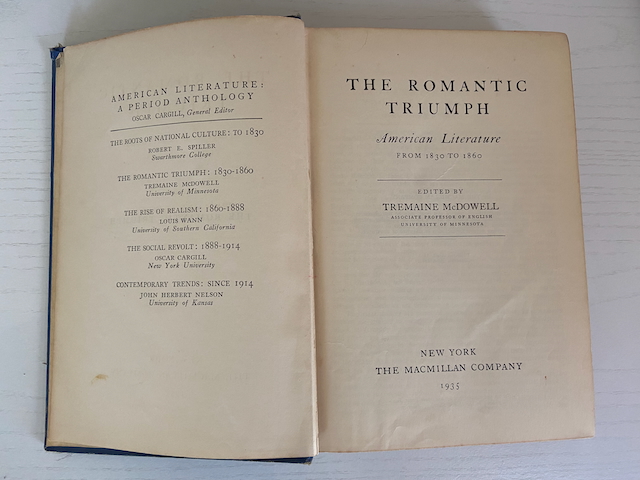
This review brings me to my American literature anthology published in 1935, The Romantic Triumph: American Literature from 1830 to 1860. These classes that I’ve briefly summarized gave me an appreciation for how deeply I can read and analyze this book before I even start reading any of its contents.

I am pretty sure I purchased this book at an antique store in north Austin, but it looks like it was previously sold by University Co-op. A quick web search yields the information that this business has been around since 1896 and sells course materials to UT Austin students, so I know this book was recirculated through this channel to be redistributed to one or more students for a literature course. And at least one of its owners was “Doris Grisham” (The name “Doris” peaked in the 1920’s and 1930’s in popularity). I see Doris’s handwriting on the margins on the pages and at least one other person’s. Some of the writing is in pencil, and some in nice-looking fountain pen ink (I learned that fountain pens, not ballpoint pens, were predominantly used during the 1930s when researching my observations about this book).

My initial question as I peruse this book is: why were these authors and selections chosen for this book? They were selected by Tremaine McDowell, Associate Professor of English at the University of Minnesota.

The book’s preface is intended to provide a justification and rationale for the editor’s selections. The first sentence reads, “The major purpose of this book is to give, from the prose and poetry of the American authors who flourished from 1830 to 1860, the most extensive readings which it is possible to print in a single volume of convenient size.”

What do you think he means by “flourished?” Is he referring to the most successful writers of these decades who flourished in terms of sales and popularity? Does he mean the writers that were most closely connected to the Romantic movement? Or just those that were “the best?” The last of these options is certainly the most subjective and puts a lot of power in the hands of this editor.

Two writers conspicuously absent are Emily Dickinson and Walt Whitman. Dickinson did not achieve literary fame during her lifetime, and it was only decades after her passing, particularly after a collection of her work was published in 1955, that she was considered an important figure in American literature. Walt Whitman, on the other hand, was a popular poet in the time period this anthology covers, but his work was probably considered too obscene or controversial to include in literary anthologies. While now, many professors like to teach and analyze the sex stuff.

Harriet Beecher Stowe’s Uncle Tom’s Cabin was a very popular work in her time but only receives a small excerpt in this collection. Clearly, she is not considered among the “masters,” whom McDowell lists as “Poe, Emerson, and Hawthorne.” McDowell writes that “[i]mportant authors are presented separated as individuals; less significant authors are grouped to exemplify tendencies and movements…”

There are other writers that are “presented separated as individuals” that I am not as familiar with. I was assigned a couple of Whittier poems to read in graduate school in a Dickinson and Whitman-centered class, but definitely nothing by Longfellow or Holmes. This caused me to be interested in why these writers, clearly part of the “canon” at the time of this book’s publication, are no longer so essential 90 years later.

When I started to research this topic, I found some complex and interesting ideas. The answers I found were not what I had expected. I had expected to find that women writers and writers of color had replaced these once-canonical figures, but that does not seem to be the reason. The answer lies more in the realm of the tastes engendered by the “new criticism” era of literary criticism, when “sentimental” works are disdained in favor of the ironic, cryptic, or gritty “tasteful” literature. When I browsed in JSTOR, I noticed that discussion of Longfellow sharply dropped off after the 1950s. The most recent paper I saw on his work was from 2014, which would make it very hard to bring his work back into the discourse without writing criticism slanted as a kind of recovery project.

My next question is: what insights can I gain from the students’ annotations and markings on the pages of this anthology? In the table of contents, works by Poe, Emerson, Thoreau, Hawthorne, Melville, and Longfellow are heavily marked. All of these, with the exception of Longfellow, were writers extensively taught in my undergraduate literature classes, so it doesn’t come as much of a surprise. But chances are, these writers were read and taught very differently then than now. Each generation of thinkers, of course, decides what to emphasize, what to minimize, and what to ignore.

There’s a lot that’s been written on what was never included among the canonical texts in the first place. Some writers, like Dickinson, never achieved any degree of fame in their own day, or were even published. Other writers, like Edith Maude Eaton (pen name Sui Sin Far) may have been popular in their day, published in magazines or in a cheaper novel format, excluded from the “canon,” then “recovered” because their works lend insight to new schools of criticism.

What did the previous owner of my book, Doris Grisham, read, and what might she have thought about it? That’s my line of inquiry as I continue to study the annotations of this text.

Slowing down to learn

Tags

, , , , , , , ,

In my last couple of posts, I’ve been discussing various texts that share a theme of autodidacticism, or self-learning. This concept caught my attention a few weeks ago when I first learned about the personal curriculum trend through a couple of YouTube videos I watched. The personal curriculum is an activity of designing a syllabus or plan for yourself over a few months, usually week by week, to learn something new.

The first literary work that I thought of when I learned about this trend was Charlotte Smith’s 1788 work Emmeline: The Orphan of the Castle. Emmeline is in an interesting position for learning in this work. She is an illegitimate daughter of deceased parents in the home of her paternal uncle. She is underprivileged in the sense that she is considered a social outcast generally, and her uncle accepts her on charity but wants nothing to do with her. She is housed in the neglected castle, largely alone except for a couple of servants, with a lot of time to explore and invent projects for herself. As I shared in a previous post, Emmeline recovers several moldy tomes from her uncle’s library that has been overtaken by nature, and she gives them to her instructor, Mrs. Carey, to augment her studies. The imagery in this chapter of her life is appealingly juxtaposed with the Enlightenment values of the day. As a gothic romance, the novel both exalts and subverts Enlightenment-era values like rationality, learnedness, hierarchy, self-determination, and the preference for the modern over the archaic. The library of forgotten texts found by Emmeline suggests a world of learning that has been obscured by modern ideals, languishing knowledge literally disappearing with dampness and mildew in a neglected library.

I wondered if those seeking a personal curriculum might have at all felt these sentiments: that something is vanishing; a desire to grasp fading knowledge before it is gone; a sense that knowledge is there but not knowing what, quite.

The modern world in which Emmeline lived shares many qualities with the modern world of today in how it is ever-fresh, looking forward, not backward, less interested in what Shakespeare said than in the new technology being invented that will cut costs and make things faster, more efficient. The gothic romance always subverts this modern, technology-forward thinking by presenting it with hauntings, madness, or obsessions that represent the repressed elements flowing uncannily back into the modern reality.

Emmeline is a late 18th century British gothic romance that speaks to the issues of its time and beyond, particularly regarding the abuse of power and wealth and the ill treatment of women left vulnerable under these power systems. A very different work in genre, being autobiography rather than a romantic novel, the 1845 The Narrative of the Live of Frederick Douglass, an American Slave is a factual account imbued with rhetoric to convince the reader that slavery is an unjust system that must be abolished.

What would Frederick Douglass, who provided such deep and stirring insights in his own time, think and say about America today? There’s no way to get his commentary directly, but it’s an interesting exercise to read his work, available all over the place, in any format desired, for free, and consider how ideas and systems in his world are still represented in a different guise.

(Or you could just type that into Chat GPT, I feel like somebody would say. I understand many people like Chat GPT. However, while I do use the Google AI, or whatever is handy, to help me convert cups to tablespoons and the like, I do not think it is appropriate to use Chat GPT to develop or share insight about humanity. The first and foremost reason is because processing and analyzing a literary work yourself changes you. A lot of different connections will form in your mind, and you will be able to relate the work to circumstances around you in all kinds of ways. You will remember the work and be able to recall it at will, or perhaps something you encounter will remind you of it. You will not have this experience from reading a couple of AI-generated paragraphs. Another reason not to use Chat GPT or other large language models is because they are “trained” from largely stolen content, and by using them, you are supporting and becoming dependent on a system of theft. The developers and executives that created these models did not care about respecting intellectual property. They also created a technology that encourages people not to think for themselves anymore. How will it benefit these executives if people become increasingly reluctant to think for themselves?)

In Frederick Douglass’ autobiography, Mr. Auld, Douglass’ enslaver, finds his wife teaching Douglass the alphabet, and chastises her. Douglass overhears this conversation, which he describes as one of the most important and insightful ones he has ever heard. Auld states that Douglass ‘should know nothing but to obey his master—to do as he is told to do…’” According to Auld, if Douglass is taught to read, “'[i]t would forever unfit him to be a slave. He would at once become unmanageable, and of no value to his master. As to himself, it could do him no good, but a great deal of harm. It would make him discontented and unhappy.’”

It is this argument that impresses onto Douglass the value of learning.

These words sank deep into my heart, stirred up sentiments within that lay slumbering, and called into existence an entirely new train of thought. It was a new and special revelation, explaining dark and mysterious things, with which my youthful understanding had struggled, but struggled in vain. I now understood what had been to me a most perplexing difficulty—to wit, the white man’s power to enslave the black man. It was a grand achievement, and I prized it highly. From that moment, I understood the pathway from slavery to freedom. It was just what I wanted, and I got it at a time when I the least expected it. Whilst I was saddened by the thought of losing the aid of my kind mistress, I was gladdened by the invaluable instruction which, by the merest accident, I had gained from my master. Though conscious of the difficulty of learning without a teacher, I set out with high hope, and a fixed purpose, at whatever cost of trouble, to learn how to read. The very decided manner with which he spoke, and strove to impress his wife with the evil consequences of giving me instruction, served to convince me that he was deeply sensible of the truths he was uttering. It gave me the best assurance that I might rely with the utmost confidence on the results which, he said, would flow from teaching me to read. What he most dreaded, that I most desired. What he most loved, that I most hated. That which to him was a great evil, to be carefully shunned, was to me a great good, to be diligently sought; and the argument which he so warmly urged, against my learning to read, only served to inspire me with a desire and determination to learn. In learning to read, I owe almost as much to the bitter opposition of my master, as to the kindly aid of my mistress. I acknowledge the benefit of both.

With this resolve, Douglass trades food with neighborhood boys for reading lessons. He focuses all available time and energy on the task because he is so sure that it will help him gain freedom.

How does literacy help Douglass gain freedom?

Douglass does not share the details of his escape in the narrative, stating he believes the details could be used by enslavers to prevent other enslaved people from escaping. He does share details of a botched attempt at escape, however, in which he writes forged passes for himself and other people attempting to escape, so it seems likely that literacy is a useful tool in his eventual successful path to freedom.

What Douglass discusses in the above passage, however, lies more in the ideological realm than practical application. He recognizes, in the fear of his enslaver, that there is a body of knowledge from which he, an enslaved person, could take and to which he could contribute that would endanger this system of power. When he learns to read, he reads the works of abolitionists. It can be inferred that his recognition of allies and sympathetic citizens strengthens his resolve and self-belief. Later, he becomes one of the most noteworthy of those writers and orators.

How hard must it be to develop the idea that something is wrong when everyone around you is telling you that is right? Or when what seems wrong to you seems fine to everyone else? I don’t know if Douglass read Ralph Waldo Emerson’s 1841 essay “Self-Reliance,” but it’s another work that makes me feel like we did not stop and do enough reading in the 1840s, learn and process ideas that could sustain us as a culture instead of just mindlessly spinning the wheels.

Society is a joint-stock company, in which the members agree, for the better securing of his bread to each shareholder, to surrender the liberty and culture of the eater. The virtue in most request is conformity. Self-reliance is its aversion. It loves not realities and creators, but names and customs.

Whoso would be a man must be a nonconformist. He who would gather immortal palms must not be hindered by the name of goodness, but must explore if it be goodness.

The word “explore” jumps out at me whenever I read this passage. It implies a certain courage, a sense of responsibility, and a need for an analytical faculty. I relate the humanities-focused personal curriculum trend to this idea because it suggests that people feel the need to educate themselves upon a structure they decide for themselves, rather than consuming what is in a “feed.”

What are the intentions behind a system? What motives can you infer are hidden behind mechanisms? A process of learning takes time. Frederick Douglass spent many years developing his faculties before successfully escaping from slavery. One thing I take from his work is that acts of change toward good are small and incremental, not large and sweeping. Each work studied, each situation analyzed is a step toward applied knowledge.

Tags

, , ,

The soft light was shimmering on the surface of the green grass, and far away, the peaks of the Jinan mountains looked blue. There was nothing to show that a tremendous event had taken place. The instant death of an entire city from a single bomb. Only in the late afternoon did they receive the radio message about Hiroshima, and Yamada still couldn’t make sense of it. How was it possible to have these light purple flowers swaying in the wind, the turtles swimming lazily in the lake, the trees spreading their branches and straining to grow as much as possible during this heatless summer and then at the same time have blinding white light, charred and melting flesh, faceless people in a city of ash? It was utterly senseless, this world. To act as though it did make sense was the greatest crime…

Beasts of a Little Land, Juhea Kim

To learn to love “others”

Tags

, , , , , ,

Mary Shelley’s Frankenstein (1831) is a text that I have read several times, at different times in my life, and at each reading, I have perceived new features and new meanings. When I thought about works that would represent autodidacticism, or self-learning, this was one that quickly came to mind because of the Creature’s incredible feat of learning.

After the Creature is brought to life through Victor’s efforts (I think everyone is familiar with the overall premise), he runs away on being abandoned by Victor. The Creature sustains himself according to instinct, eventually finding himself outside a cottage of individuals who interest him. He watches their lives and learns the German language through listening through the window to a young man, Felix, teach his Turkish fiancee, Safie, German. He also learns to read in the same way. This sounds rather unbelievable unless I compare it to autobiographical texts of individuals attempting to teach themselves to read. The Narrative of Frederick Douglass (1845), an incredible work I want to talk about in much more detail in later posts, has convinced me more than any other texts that certainly, where there is a will, there is a way, regarding self-learning.

Frederick Douglass’s motivation to learn to read is to acquire knowledge that will allow him to be free from slavery, and he succeeds wonderfully at this, to become a compelling author and orator. A fictional character, the Creature’s reasons for learning are indistinct and are open to interpretation. In fact, Frankenstein is so very much open to interpretation as a text that I feel it could be applied to every contemporary social problem to provide insight.

Why does the Creature learn? The Creature could be interpreted as super-human, as in possessing qualities that supersede that of humans, both physically and mentally. He could also be interpreted as other-than-human, especially in how Victor, his human creator, is repulsed by him at his first sign of life. Another mystery (before I have fully described the first mystery) is why the Creature is transformed from a miraculous creation to an abject being the moment he opens his eyes and looks at the world:

I saw the dull yellow eyes of the creature open; it breathed hard, and a convulsive motion agitated its limbs. How can I describe my emotions at this catastrophe, or how delineate the wretch whom with such infinite pains and care I had endeavored to form? His limbs were in proportion, and I had selected his features as beautiful. Beautiful! Great God! His yellow skin scarcely covered the work of muscles and arteries beneath; his hair was of a lustrous black, and flowing; his teeth of a pearly whiteness; but these luxuriances only formed a more horrid contrast with his watery eyes, that seemed almost of the same colour as the dun-white sockets in which they were set, his shrivelled complexion and straight black lips.

On the one hand, the Creature is constructed from exhumed corpses and, no doubt, possesses a cadaverous appearance, but why is this appearance so beautiful to Victor when he is nonliving, and so repulsive when he is living? To me, this is one of those questions for us to consider inwardly and draw our own conclusions.

As far as the Creature’s learning powers, we can conclude that Victor’s efforts to create this extraordinary human are successful, because his inner drive to learn propels him at dizzying speed from zero to building philosophical frameworks from copies of Paradise Lost, Plutarch’s Lives, and The Sorrows of Werter he finds in an abandoned satchel in the woods at some point.

Where things really start to go wrong for the Creature: he develops a deep love for the inhabitants of the cottage he watches and cares for day after day, covertly gathering firewood and doing whatever he can for them. He gathers his courage and introduces himself to the blind patriarch of the family one day, when other inhabitants of the cottage are away, who treats him with great warmth and interest. The cottage’s other inhabitants arrive, exclaim in horror at the Creature’s ghastly appearance, and disturb the man with whom the Creature has forged a quick bond.

Rejected with a quick but deep disgust from these humans, the Creature flees the cottage, where things move from bad to worse throughout the story. Nurtured by the literature he finds, his sensibilities are cultivated to a height that makes him long for social connections and idea exchange. After another confrontation with Victor, his creator, in which Victor is very cruel to him, the Creature begins murdering people, many of whom are beloved by Victor, for whom the Creature has acquired a deep hatred and resentment. On the one hand, Victor feels profound shame and guilt, knowing he is in some way the cause of these deaths, but on the other hand, he does not take responsibility or confess the truth to authorities, which I presume to the reader (at least to myself) makes him the actual object of disgust as the narrative advances and the murders accumulate.

The elephant in the room is how Victor repeatedly beats himself up for having brought this “monster” to life but never considers how his initial and subsequent treatments of the Creature on contact are what have rendered this exquisitely sensitive super-human (if I may call the Creature such for this interpretation) so alienated, so despairing, and so blindly violent that with each killing of other humans, he descends into greater misery that necessitates further killing. As with much of Frankenstein, I read these behaviors as more allegorical than textually accurate. I have no idea what motivates real-life killings and would not presume to speculate. I think that elephant in the room is Victor’s lack of real care for others outside his circle of familiars, even allowing an innocent woman to be hanged for the murder of his younger brother when he knows his Creature is responsible.

There is so much in the text that it’s quite beyond my power to explicate: a flawed justice system; violence and prejudice against women; a dearth of emotional intelligence in, well, most of the people in this story, with the exception of the Creature, who feels and understands far too much, and is far too physically powerful for his own good. Like a profound dream, one cannot make the ends all match up. The truths in the novel must be derived intuitively, if imperfectly, and turned over in the mind, over time.

I believe that Victor, the dangerously powerful and intelligent but short-sighted scientist, is in every human, giving us the ability to overstep our emotional capabilities with our ambitions and harm others, even fatally; and the Creature, the individual who is deeply wounded, blindly feeling, and also dangerously powerful, in a physical sense, is in us as well. I know that I go on my shame spirals when I think about my past incidents of cruel and unthinking hurt toward others, that went so diametrically opposite my supposed principles, motivated by thinking of others as less than myself in some way or other; and I know that I also mournfully gather my cat against my heart in the bed and gaze at the morning light outside the window, feeling like a wounded and misunderstood animal, forsaken by every other human in the world.

What can I take from Frankenstein on this reading? The world that whirls by these windows is surely a different world than on my previous readings. It’s a world constantly riven by physical violence on bodies and mental and emotional violence through electronic communications that manipulate our fears and desires, windows into certain presentations of others’ lives and ideas that carve us with loneliness and despair and drive many people into tribes and/or abject solitude. How would Frankenstein be different if the cottagers had not reacted with revulsion at the Creature’s appearance? This is surely a moment at which the reader feels great disappointment after following the incidents of their lives, and beginning to love them through the Creature’s eyes.

But they did. And we do. I think we’re the cottagers, too.

A revival of autodidacticism

Tags

, , , , , ,

Recently, I came across a YouTube video in which someone was sharing their “personal curriculum” for the fall. I was really interested by this idea and watched a few more videos on the same topic.

The idea of a personal curriculum is that of designing a course schedule or syllabus for yourself similar to what a university professor would design for students, but of course, you can choose content that is of most interest to you. For instance, maybe there are literary novels that you’ve had lying around for ages that you really want to read, or even an entire run of a show that you want to re-watch. Your “classes” could include learning a language or working on a skill like crochet. I did notice that all of the videos I found on this topic were by woman, and nearly all of their ambitions involved the humanities. More observations to capture my interest.

I have definitely wondered for years whether I should have enrolled in graduate school to get my post-baccalaureate degrees, or just done something like this for myself around ten years ago. Especially since I have come full circle and find myself doing the identical job that I was then, and learning Mandarin and conducting literary research on the side (which I was not doing then). I’m sure a lot of people with similar inclinations as myself wonder about such things. Maybe people even wonder about what is worth learning or struggle between passions and an investment in a career that “makes money.”

Well, I don’t know about graduate school now, because honestly, it seems like education has changed a lot in the past several years, but I think I managed to squeeze in when it was good and got something really good out of it. It’s simultaneously the sublime Mont Blanc of my life and the deepest, darkest shadow of my career that has earned even a jeer from a prospective employer in a job interview (thankfully never hearing from them again). I was privileged in being able to afford to go to graduate school to follow my passions and then find a job afterwards, even though most prospective employers may have considered it a disadvantage to me. Back in the work force, I try different things to keep my scholarly candle burning, and that’s why the personal curriculum caught my attention. I will say, for what it’s worth, that I have infinitely more time for research and scholarly growth in the humanities in my after-hours as a microbiologist than I did in my one-year stint as a non-tenure-track professor, so I’m glad I didn’t spend more time than that trying to “use” my post-baccalaureate degrees.

Autodidacticism has a documented history going hundreds of years back, but when I started thinking about it, I remembered the opener of Charlotte Smith’s 1788 novel Emmeline: The Orphan of the Castle.

With no other notice from her father’s family, Emmeline had attained her twelfth year; an age at which she would have been left in the most profound ignorance, if her uncommon understanding, and unwearied application, had not supplied the deficiency of her instructors, and conquered the disadvantages of her situation.

Mrs. Carey could indeed read with tolerable fluency, and write an hand hardly legible: and Mr. Williamson, the old steward, had been formerly a good penman, and was still a proficient in accounts. Both were anxious to give their little charge all the instruction they could: but without the quickness and attention she shewed to whatever they attempted to teach, such preceptors could have done little.

Emmeline had a kind of intuitive knowledge; and comprehended every thing with a facility that soon left her instructors behind her. The precarious and neglected situation in which she lived, troubled not the innocent Emmeline. Having never experienced any other, she felt no uneasiness at her present lot; and on the future she was not yet old enough to reflect.

At every turn, Emmeline reflects the ideal human of her time. She is not only highly intelligent but also highly sensitive, qualities enabled by a strong intuitive faculty. She is considered illegitimate by her father’s family and is thus neglected, living nearly forgotten under her paternal uncle’s auspices. The exceptional wit and logic Emmeline shows in her future trials is presumably a product of her self-education undertaken at her own natural propensity for learning.

Her mind, however, gradually expanded, and her judgment improved: for among the deserted rooms of this once noble edifice, was a library, which had been well furnished with the books of those ages in which they had been collected. Many of them were in black letter; and so injured by time, that the most indefatigable antiquary could have made nothing of them.

From these, Emmeline turned in despair to some others of more modern appearance; which, tho’ they also had suffered from the dampness of the room, and in some parts were almost effaced with mould, were yet generally legible. Among them, were Spencer and Milton, two or three volumes of the Spectator, an old edition of Shakespeare, and an odd volume or two of Pope.

These, together with some tracts of devotion, which she knew would be very acceptable to Mrs. Carey, she cleaned by degrees from the dust with which they were covered, and removed into the housekeeper’s room; where the village carpenter accommodated her with a shelf, on which, with great pride of heart, she placed her new acquisitions.

The dismantled windows, and broken floor of the library, prevented her continuing there long together: but she frequently renewed her search, and with infinite pains examined all the piles of books, some of which lay tumbled in heaps on the floor, others promiscuously placed on the shelves, where the swallow, the sparrow, and the daw, had found habitations for many years: for as the present proprietor had determined to lay out no more than was absolutely necessary to keep one end of the castle habitable, the library, which was in the most deserted part of it, was in a ruinous state, and had long been entirely forsaken.

Emmeline, however, by her unwearied researches, nearly completed several sets of books, in which instruction and amusement were happily blended. From them she acquired a taste for poetry, and the more ornamental parts of literature; as well as the grounds of that elegant and useful knowledge, which, if it rendered not her life happier, enabled her to support, with the dignity of conscious worth, those undeserved evils with which many of her years were embittered.

Emmeline’s library could be a dream rendered by a dark academia ambiance video or photo shoot today: a young woman nearly alone in a crumbling castle discovers a library of ancient texts that is being overtaken by nature. As she explores the volumes, her companions are soft-spoken birds that have taken roost in the vast, abandoned room. Her natural intelligence leads her to discern and select an impressive array of the works to create her own personal curriculum placed in her teacher’s room. The content of these works serves to strengthen her mind and spirit through the series of dramatic trials that she will suffer throughout the course of the novel.

Implicit, then, in this gothic romance in the Age of Enlightenment, is the idea that the wisdom in these literary and philosophical works will sustain Emmeline against the trials of life. Could it be that people today are starting to feel that way? Is this why they are choosing so much humanities-based learning in their personal curriculums? Because even if the humanities can’t “make money,” these topics offer us intellectual and spiritual fruit to strengthen us against our cultural wasteland.

Quote

My achievements seem so humble
While you’re making wine from water
While my hand work the cold soil
All you touch turns into gold
And I don’t wanna be like you

I don’t wanna be like you
It seems like you outrun me every time
I want to be you
Why can’t I erase you from my mind

— Delain, “Invidia”